Home About Me Freebies Image Map
Showing posts with label Math. Show all posts

Thursday, July 10, 2014

Guided Math: Chapter 7

I'm linking up again with Amanda from The Primary Gal for Chapter 7 of the "Guided Math" book study! This chapter is all about conferring with students, which is something I feel that I need to improve on and do more often.


I have to admit that I used to be on the “old school” side of teaching, when I first started. I would determine my students’ mathematical thinking by looking at their final product. “Yep, he got it”….or “Oh no! He’s got no clue.”

Over the years my teaching style has changed a lot. I went from teaching straight from the textbook, to math centres, to problem based learning and now to guided math. I think that guided math, works well with the centre and problem solving approach to math. It’s the next stepping stone up.

So how do I discover my students’ mathematical thinking? I do it in two ways. I ask them during informal or formal conferences. I also check in with them.

I try to use questions like: “So what have you done so far?” or “What do you know about the problem/question?” Keeping the questions open allows the students to explain their thinking. When students are stuck, I will ask them if there is a strategy or a tool that they could use to help them solve the question/problem. I find sometimes they just need encouragement and to know that it’s okay to try.


Ideally, I like to confer with my students at least 3 times a week. Does it happen? Let’s be realistic, not often. More realistically we are looking at once maybe twice a week, depending on the student.

Here is why… there is a sense of learned helplessness in my classroom sometimes.  Even if, I’m wearing my stop sign students will still come up and ask for help, even though they know that they can’t interrupt.

 However, I sometimes feel that interrupting is better because if they don’t interrupt then they are off task and fooling around.

I sat down with my students last year and we brainstormed a list of stratgies that they can use when they are stuck. Since creating and posting this posters in my classroom, interruptions have decreased dramatically. If a student interrupts, I point to our strategy wall and they know what to do.

The strategies that I use are part of my Problem Solving Strategy Set.


Don't forget to enter this weeks giveaway!
a Rafflecopter giveaway

And check out what my blogging buddies have to say about this weeks chapter.


post signature

Thursday, June 12, 2014

Guided Math Book Study: Chapter 3

 I'm excited to be back this week for Chapter 3 of the "Guided Math". Amanda from The Primary Gal is hosting this book study. I have to say that I am really enjoying this book and am learning so many practical and useful things from this book. I can't wait to try them out.

When my first graders come in, the first thing they do is get out their calendar books. The students write down the number of the day then graph what the weather is like in their books. For the first few months of grade 1, the students trace the number. Once they become more comfortable, they start to write in the number them selves.

2014-2015 will be updated soon!

We then meet on the carpet for our calendar routine on the SMARTboard. I like using the SMARTboard for calendar because it doesn't take up so much room. We fill in the calendar together. We usually have a pattern for the numbers. This month our pattern is AAB. 
We practise counting the numbers in different ways (1s, 2s, 5s and 10s). I usually ask them a problem that has to do with the calendar and have students explain their strategies for solving the problem, i.e. "If there are 22 days of school, how many days until we go on our trip to African lion Safari?"

We then fill in the days of the weeks, graph the weather, and tally the number of days that we have been in school.


We then move into language. 

So far this is my favourite chapter in the book. It has really made me think about my math block and what I can do to improve my creating of a mathematical community.

The idea of starting the day with  math stretches that are simple and don't take up a lot of time has me excited.

I like the idea that each day starts with a different type of math stretch, but that the students are familiar with them.
  • data collection (a simple graphing activity) It allows students to respond as the graph is filled. Its very similar to what I use at the beginning of the year to sign in.
  • number of the day - represent the number in a variety of different ways
  • what's next - begin the pattern and then leave a blank for each student.
  • "How did my family use math" - helps students to make real world authentic connections with mathematics
  • "Makes me think of..."- allows students to show what they know about the topic.

Calendar
I also like how Laney suggests adding more to your calendar. I find that at this point in the year, I am tired of my calendar routine and so are the kids. Let's be honest, we were probably bored back in October.

Things that Laney suggested adding to your calendar routine: calendar cards that help practice a skill, i.e. fractions, shapes, time, etc...; measuring the temperature; an estimation challenge; incredible equations (give the students a number and they make equations); a problem of the day.


Check out my new math themed calendar cards. 

So there you have my thoughts on Chapter 3.


Don't forget to enter the give away.

Sunday, June 8, 2014

Diggin' Into the Math Workshop


 I'm linking up again this week with Laura from Where the Magic HappensI was blown away by the number of people who visited my blog last week. Thank you so much. 
Today I'm diggin' into the way I organize my math block. My last post was about how I organize my classroom, and I admitted that I wasn't very organized, especially my desk.  I have to say though my math block is very organized.


Whole Class Instruction
Everyday we start our math block with a whole class lesson. Usually 5 to 10 minutes. I try to make this quick so the students aren't sitting on the carpet too long. 

Depending on the task for the day this lesson maybe a variety of different things:
  • a mini lesson
  • a game (my students love playing games with flash cards)
  • an introduction to the math centres
  • an introduction to a problem

Centres
Throughout the week I will have a variety of centres. My school board is moving towards recursive instruction. Instead of teaching full units, like patterning and then  not touching it for the rest of the year, we continue to give the students opportunities to practice the skills throughout the year.

Therefore, I will have one or two centres were students will practice a new topic, i.e. time. In the remaining centres students will revisit different topics, i.e. geometry, sorting and graphing, and money.

Problem Solving
Twice a week, I do a three part lesson:

Part 1: A mini lesson to set up the problem (5 min)
Part 2: Time to solve the problem (20-30 min)
Part 3: Reflect and Connect - students share the strategies they used to solve the problem and the other students give feedback.

I was involved with a program within my school board called CIL-M (Collaborative Inquiry in Learning in Mathematics). We worked with a variety of teachers from around our board, consultants, and principals to create open ended problems to try in our classroom. 

This was an eye opening experience for me. The right problem can reach all students. The wrong problem can be a disaster. :)


I plan to make two changes next year. 
  1. I want to integrate technology into my centre time. I have created a time QR code game that my students absolutely loved. So I plan to make more. It allows them instant feedback to see if they are right or not.

  2. GUIDED MATH, I am part of a book study this summer called "Guided Math" by Laney Sammons. It is an amazingly easy read. 

I'm excited because I'm already doing most of the things that Laney suggests but I can't wait to add the guided component to the math workshop as well.


Here are some products that are multi-strand math centres. Click on the pictures to see the item in my store.


These activities are great for centres.


I absolutely love these problem solving posters.


Thank you so much for stopping by! Don't forget to hop back over to Laura's Blog to continue through all of the posts.


post signature

Thursday, June 5, 2014

Guided Math Book Study: Chapter 2

I have linked up with Amanda from The Primary Gal again, this week to bring you my thoughts on Chapter 2 of Laney Sammons book, "Guided Math".

Laney Sammons believes that there are 7 foundational principals of Guided Math. The two principals that struck me are: "All children can learn math." and "Learning at it's best is a social process"

"All children can learn math." 
This one is an eye opener for me. Not that I didn't think that all children could learn math. I always felt myself as a learner that I just couldn't do math...I didn't have the ability to do it...I just wasn't a math person. It's only recently as a teacher that I have begun to fully understand some math concepts. I feel that many parents and students fall back on the belief that their child's lack of achievement is based on inability. However, if we change that misconception and believe that all children can learn math, then think of all of the possibilities this opens up.

"Learning at its best is a social process."
I am a firm believer in the fact that students working together on the same idea enhances student learning. Every since I began my teaching career, I have felt passionately about that. My classroom is designed on that principal. All of the students desks are in groups. I have a variety of tables and spaces around the room where students can work together. I have to say my classroom is rarely quiet.


 Sense of Community
A new student would be able to see and feel a sense of community in my classroom. They would see students working together and showing respect towards all of their classmates. They would see students taking risks and knowing that mistakes are a part of learning. 

Classroom Arrangement
Laney, believes that the arrangement of the classroom is important for guided math to be effective. The arrangement of my classroom encourages socialization. It facilitates movement and allows for easy access of math manipulatives and materials.

Home Area
The students desks are in four groups of between 5 and 6 students. Each group is given a colour.

Large Group Meeting Area
I received a beautiful new carpet this year. This is our large group meeting space. This area is directly in front of our SMARTboard which we use every morning for our calendar activities as well as many other lessons.

Small Group Area
I have a guided reading table where I meet to conference with students. We call it our rainbow table, since it is shaped like a rainbow.


Math Workshop Area
The rest of my classroom is the math workshop area. Groups of students can work on a variety of centres throughout the room, either at the different colour groups, on the floor or at two round tables. 

Organization and Storage of Materials
I feel very fortunate, to have a wealth of math tools in my classroom. Many of the math tools I inherited when I moved into my classroom.  I came from a very resource poor school, so it was a wonderful surprise.
I have all of our math tools on a shelf at the front of the classroom where students can see them as well as access them easily. The organization of them was driving me insane last summer, so I took pictures of each of the math tools and created labels.

Numeracy Rich Environment
A student walking into my classroom would see a numeracy rich environment. They would see both student created and teacher created anchor charts and posters around the classroom. 

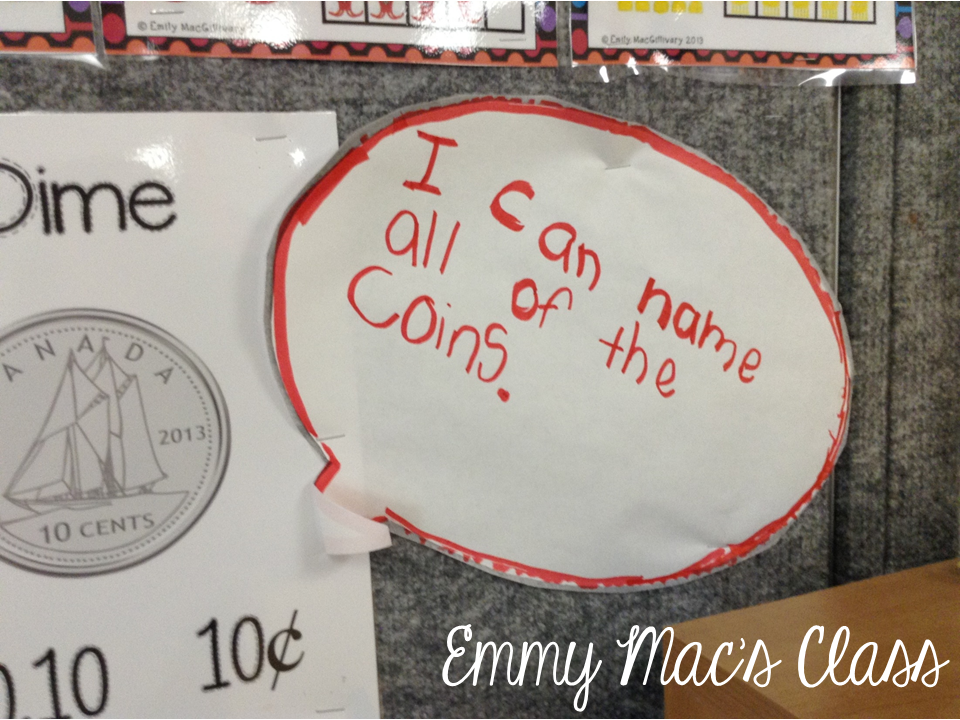
This student would see student created "I can" statements. I use a giant speech bubble for them to record their "I can" statements.


 I decided on a monster theme for my classroom this year, so many of my student reference posters are monster related.

Click HERE to check out more of my math poster themes:

I love the idea of building a numeracy rich environment, and I'm happy to see that I am already doing some of things that Laney suggests, but I would like to build a richer numeracy environment. There are many things that I would like to try next year.

Math Journals
I use an interactive reading journal. If we are taking the idea of Guided Reading and turning it into Guided Math why not take a reading journal and create a math journal or notebook instead?


Check out some of my fellow bloggers great interactive math notebooks.
Totally Sweet Math Centers by Tabitha
Diary of A Not So Wimpy Teacher
Primary Possibility - Stephany Dillon


Tabitha from Totally Sweet Math Centers by Tabitha was so super sweet, she gave me three samples of her Interactive Math Notebooks. Click on the links to try them out.
Addition and Subtraction Grade 1
Addition and Subtraction Grade 2
Place Value


Measuring Tools
I think Laney had a valuable point. Measuring tools need to be integrated! 

Math Related Children's Literature
This is something that I do, but I need to do more often. Reading math related children's books allows students to make mathematical connections

Check out this amazing list by Love2Learn2day full of math related children's literature organized by topic!

Math Books by Student Authors
Umm...brilliant idea! We make our own books all the time. Never thought of making our own math books!

Don't forget to enter the rafflecopter, for your chance to win a $50 gift certificate!!!!!!


a Rafflecopter giveaway


post signature