Home About Me Freebies Image Map

Monday, June 16, 2014

Diggin' into Behaviour Management and a Freebie!


I am back again this week to link up with Laura from Where the Magic Happens to bring you the next topic in the "Diggin' Into Next Year" serious. This weeks topic is Behaviour Management.

To be perfectly honest, this is the area that I think I am great at, I think it comes down to growing up with a mom who was a teacher and who had a pretty amazing "teacher look". I perfected that look early on in my teaching career. In all seriousness though, most days after school when I was in high school, I helped out in my mother's classroom. I learned a lot about classroom management from her. I have also taught at some tough schools. Being sworn at, having chairs thrown at me or being pushed into the wall were weekly if not daily occurrences.

When I first started teaching  I had the opportunity to attend a week long TRIBES workshop.  The main idea behind TRIBES is to build a learning community in your classroom, and I honestly feel that when that is built, a lot your classroom management issues disappear. TRIBES has really shaped my philosophy on classroom management. Does anyone else use the TRIBES program?

I have tried a few things that I quickly decided that I wasn't going to use. I thought I would briefly touch base on them and tell you why I personally chose not use them. Please note that if these programs work for you that's great. They just weren't for me.

Coloured Card System
My second year of teaching I was introduced to a strategy. Each student was given a pocket on a chart. In each pocket there was a green, yellow, orange, red and black card. Every morning students started with the green card at the front. If they made a mistake or a poor choice the card was changed to yellow, and then orange and so on. At the end of the day the students filled in a square on the calendar with the colour that they ended the day on. 


I don't use this system because I feel that this system draws attention to the bad behaviour or the unwanted behaviour. It also singles out the student that is making the poor choice, everyone knows that the student is in trouble.  

 My oldest daughter's class used this system in first grade. Every day she would come home and tell me that she was on green. She would also tell me if someone got on red. The day that she had to change her card she was devastated. If I hadn't already chosen not to use the card system I would have stopped immediately. However, she probably never spoke when she wasn't suppose to again.

1-2-3 Magic
Another strategy I tried last year, since my teaching partners were using it was called 1-2-3 Magic. All of the students start on 1. Each student has a clothespin, if they make a poor choice the students clothespin is moved up to 2. If the students clothespin gets to 3 they have to take a 5 minute time out. I personally didn't like this program for the same reasons above. I found that students felt singled out. As well, it was disruptive when students had to leave during a lesson to have a time out.

That being said I found that this strategy worked well at home with my own girls. We went through a rough patch when we needed a system like this. 


When it comes to classroom management I try to encourage the positive instead of the negative.

Class Agreements
One of the first things I do with my students in September is to make a set of class agreements. These are things that we will do, not things that we can't do. (i.e. We will raise our hands, instead of "No yelling out!") I try to keep it to about 5 or 6 agreements, but I let the students come up with them. When we are happy with them the students sign the bottom of the chart to say that they agree to them. 

Class Goals
Throughout the year we make class goals. It's something that the students think they need to improve (this is student created). This month our goal is to work quietly. When the students are working quietly I will colour in one or two gumballs. They also chose a prize when they fill in the all of the gum balls. This month's prize is an extra gym period.


Click HERE or on the picture to download a free copy of the goal setting sheets I use in my classroom. 

Class Store
Each of my students has their own wallet, I use an envelope that each student decorates and is responsible for.
An example of a student's wallet. It has definetely seen better days!

 I have photocopied and cut out pennies on brown construction paper, nickels and dimes on grey construction paper. The money below is about four years old, it lasts a long time. When I see students making good choice, I will give them a coin. That they store in their wallet.


Counting how much money she collected. Man my hands are getting old looking. :(

 Every other week, we have a class store and students can buy items. I have a 6, 12, 18, 25, and a 50 cent bag. Some students love to save up their money while, other students love to spend right away


Here are some examples of the prizes in each of the bags.

What I love...
I love that students get practice counting money and making change. They also have to be responsible for their wallet and money. It also reinforces positive behaviour.

Thanks so much for stopping by. Don't forget to hop back over to Laura's page and continue through the hop.


post signature

Saturday, June 14, 2014

You Oughta Know: A Blog Hop

"You Oughta Know" is the brain child of Jasmine over at "Buzzing with Mrs. McClain."

So what do I think you oughta know? I mentioned at school what I was thinking I was going to share, and I got some strange looks. But here we go anyway. 

I think "you oughta know" that plastic fruit/veggie trays are amazing! I have a collection of about 10 trays that I use all the time. They are perfect for anything that you need to sort.

Here are some of the ways that I use these trays in my classroom.

1. To organize supplies for the students. These are way cheaper then the ones that I bought from Scholastic and work just as well. 


2. During math centers. These are great for hands on sorting activities.

3. This is my favourite. For keeping Plasticene sorted. My students love Plasticene. I put two colours in each section. Any used or mixed up pieces the student store in the centre. Way easier then throwing it all in one bin.


Next time you go to recycle your fruit/veggie tray, stop and think what it could be used for. 

I'd love to hear how use your fruit/veggie trays in your classroom and at home.


post signature

Thursday, June 12, 2014

Guided Math Book Study: Chapter 3

 I'm excited to be back this week for Chapter 3 of the "Guided Math". Amanda from The Primary Gal is hosting this book study. I have to say that I am really enjoying this book and am learning so many practical and useful things from this book. I can't wait to try them out.

When my first graders come in, the first thing they do is get out their calendar books. The students write down the number of the day then graph what the weather is like in their books. For the first few months of grade 1, the students trace the number. Once they become more comfortable, they start to write in the number them selves.

2014-2015 will be updated soon!

We then meet on the carpet for our calendar routine on the SMARTboard. I like using the SMARTboard for calendar because it doesn't take up so much room. We fill in the calendar together. We usually have a pattern for the numbers. This month our pattern is AAB. 
We practise counting the numbers in different ways (1s, 2s, 5s and 10s). I usually ask them a problem that has to do with the calendar and have students explain their strategies for solving the problem, i.e. "If there are 22 days of school, how many days until we go on our trip to African lion Safari?"

We then fill in the days of the weeks, graph the weather, and tally the number of days that we have been in school.


We then move into language. 

So far this is my favourite chapter in the book. It has really made me think about my math block and what I can do to improve my creating of a mathematical community.

The idea of starting the day with  math stretches that are simple and don't take up a lot of time has me excited.

I like the idea that each day starts with a different type of math stretch, but that the students are familiar with them.
  • data collection (a simple graphing activity) It allows students to respond as the graph is filled. Its very similar to what I use at the beginning of the year to sign in.
  • number of the day - represent the number in a variety of different ways
  • what's next - begin the pattern and then leave a blank for each student.
  • "How did my family use math" - helps students to make real world authentic connections with mathematics
  • "Makes me think of..."- allows students to show what they know about the topic.

Calendar
I also like how Laney suggests adding more to your calendar. I find that at this point in the year, I am tired of my calendar routine and so are the kids. Let's be honest, we were probably bored back in October.

Things that Laney suggested adding to your calendar routine: calendar cards that help practice a skill, i.e. fractions, shapes, time, etc...; measuring the temperature; an estimation challenge; incredible equations (give the students a number and they make equations); a problem of the day.


Check out my new math themed calendar cards. 

So there you have my thoughts on Chapter 3.


Don't forget to enter the give away.

Monday, June 9, 2014

100 Minute Book Study: Chapter 5


Today's post is being hosted by Dilly Dabbles Blog. Click HERE to read what she has to say.

Writing Time/Direct Instruction in Writing:
So I've been struggling with how the writing time, at the end of the block, will help my students when it isn't followed by the consolidation piece. This chapter has cleared up a lot of my questions.

Writing time is a great time to create clear learning goals and success criteria with the students. Students can share their writing. You can also look at Mentor texts, which is a great way to co-create success criteria. It's also an opportunity to look at exemplars as well as modelling writing. 

What I was envisioning was a variety of modeled lessons, with no immediate follow through. After reading this chapter, things are so much clearer. I also realized that I can continue to do a lot of things that I am already doing. 


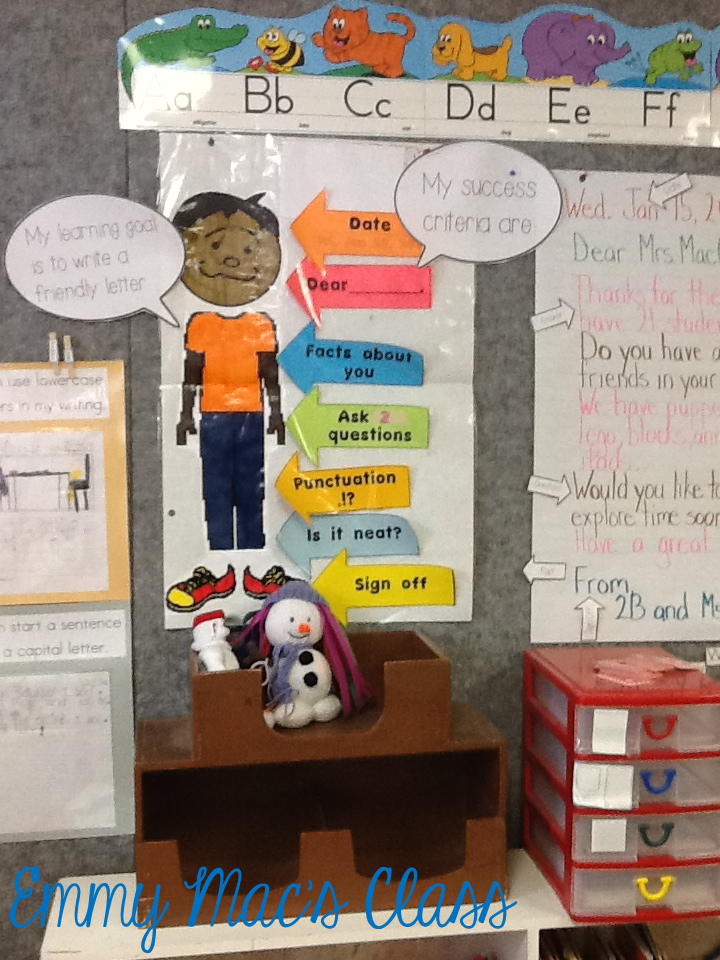
Here is an example of the success criteria that we created for letter writing.


We deconstructed  a letter using the success criteria that we co-created.


Students deconstructed their own writing with a partner to create class exemplars.


This is an example of a shared letter that the class wrote. We used a checklist to make sure that we had all of the success criteria.

To take a closer look at my "Writing Friendly Letters with Learning Goals and Success Criteria", click on the picture. 

To see my other writing products with Learning Goals and Success Criteria click HERE.


 post signature

Monday Meet Up with TTT


 I'm linking up again with The Teaching Tribune for their Monday Meet Up!

This weeks is all about me!
 I TEACH: I teach first grade, or as we like to say grade one, in Ontario, Canada. I love first grade for nine months of the year! September in grade one is so hard! Harder than any other grade that I've taught. 

I HAVE: an amazing family, even if the little one is hiding. She was watching out for alligators.


I have two beautiful little girls. They are finishing off Grade 2 and Senior Kindergarten. They just competed in their first tennis tournament and won Silver and Gold. 

 I have been married to my husband for 10 years! It's hard to believe it has been that long. He thinks he's funny!


 He's really Not! I am way funnier.


 However in all seriousness we make a great team.

I watch: I don't watch much. I used to be an avid TV watcher, especially CSI and reality shows. But, kids shows have taken over my life. Most nights I am too tired to get up and find the remote so I can change the channel. Unless it's Caillou, then you should see me move. I can't stand Caillou. 

If I'm going to watch something it's likely to be an action movie. I love car chases, fight scenes and all out craziness.

I LISTEN: I listen to top forty in the car. But mostly I listen to my children singing "Let it Go!" over and over and over again.

I READ: I read everything. I read every chance I get. I have a few favourite authors that I will read again and again, while I'm waiting  to find the next great read.

Kelley Armstrong, and Illona Andrews are by far my favourite authors.

Have you watched Bitten yet? The show is based on Kelley's books! I was so excited when they decided to make the books into a TV Show, especially since I live in the real BEAR VALLEY! It was amazing watching our little Canadian town turn into a little American town. The Bear Valley Diner is really a costume shop. The Sentinel is now a music school!

 I DO: I used to do a lot of running, now I just do a lot of running around. Taking the girls from violin practice, to tennis, to soccer. It feels like I never stop!

Thanks so much for taking the time to stop by my blog today! 


post signature

Sunday, June 8, 2014

Diggin' Into the Math Workshop


 I'm linking up again this week with Laura from Where the Magic HappensI was blown away by the number of people who visited my blog last week. Thank you so much. 
Today I'm diggin' into the way I organize my math block. My last post was about how I organize my classroom, and I admitted that I wasn't very organized, especially my desk.  I have to say though my math block is very organized.


Whole Class Instruction
Everyday we start our math block with a whole class lesson. Usually 5 to 10 minutes. I try to make this quick so the students aren't sitting on the carpet too long. 

Depending on the task for the day this lesson maybe a variety of different things:
  • a mini lesson
  • a game (my students love playing games with flash cards)
  • an introduction to the math centres
  • an introduction to a problem

Centres
Throughout the week I will have a variety of centres. My school board is moving towards recursive instruction. Instead of teaching full units, like patterning and then  not touching it for the rest of the year, we continue to give the students opportunities to practice the skills throughout the year.

Therefore, I will have one or two centres were students will practice a new topic, i.e. time. In the remaining centres students will revisit different topics, i.e. geometry, sorting and graphing, and money.

Problem Solving
Twice a week, I do a three part lesson:

Part 1: A mini lesson to set up the problem (5 min)
Part 2: Time to solve the problem (20-30 min)
Part 3: Reflect and Connect - students share the strategies they used to solve the problem and the other students give feedback.

I was involved with a program within my school board called CIL-M (Collaborative Inquiry in Learning in Mathematics). We worked with a variety of teachers from around our board, consultants, and principals to create open ended problems to try in our classroom. 

This was an eye opening experience for me. The right problem can reach all students. The wrong problem can be a disaster. :)


I plan to make two changes next year. 
  1. I want to integrate technology into my centre time. I have created a time QR code game that my students absolutely loved. So I plan to make more. It allows them instant feedback to see if they are right or not.

  2. GUIDED MATH, I am part of a book study this summer called "Guided Math" by Laney Sammons. It is an amazingly easy read. 

I'm excited because I'm already doing most of the things that Laney suggests but I can't wait to add the guided component to the math workshop as well.


Here are some products that are multi-strand math centres. Click on the pictures to see the item in my store.


These activities are great for centres.


I absolutely love these problem solving posters.


Thank you so much for stopping by! Don't forget to hop back over to Laura's Blog to continue through all of the posts.


post signature